
Most gym owners don’t realize their body composition machine is giving them questionable numbers until a client asks why their results shifted dramatically after a single meal. Body composition machines vary wildly in accuracy, and the gap between a consumer-grade device and a clinical-grade system matters more than most people expect. Hydration levels, food intake, and test timing can all skew results by several percentage points. After reviewing dozens of options across clinical settings, gym chains, and performance facilities, this guide covers the five most credible machines on the market right now.
The research approach for this ranking was pulled from publicly available sources: official product pages, verified customer reviews, clinical validation documents, awards records, and fitness industry case studies. Only companies with documented real-world results in fitness technology made the cut. Options with unverifiable claims or thin track records were removed early in the process.-> See the full research breakdown
- InBody USA – Best for corporate wellness programs, gyms, and medical facilities requiring clinical-grade accuracy
- Akern – Best for healthcare professionals and sports organizations needing certified medical-grade BIA devices
- ACCUNIQ – Best for fitness centers and gyms requiring accurate body composition analysis with IoT connectivity
- Bodystat – Best for portable, cost-effective body composition and fluid monitoring in fitness and clinical settings
- Evolt Health – Best for gym chains and fitness networks seeking connected body composition analytics at scale
Why Body Composition Machines Matter
Choosing the wrong body composition machine doesn’t just waste budget. It erodes client trust when numbers feel inconsistent or hard to explain.
The challenge with BIA-based devices is real. Hydration levels, meal timing, and testing conditions all affect results, which means accuracy variability isn’t a flaw in one brand but a technical reality across the entire category. Without standardized testing protocols, comparing results across different machine types becomes nearly impossible.
Gold-standard methods like DEXA and Bod Pod deliver the benchmark numbers, but their cost puts them out of reach for most fitness facilities. That’s exactly where well-chosen commercial-grade machines earn their place.
The right device gives your team something they can actually act on: reliable percent body fat readings that hold up across testing sessions, skeletal muscle mass tracking in measurable units, and visceral fat scoring that clients can understand. Those outputs alone can anchor an entire progress-tracking program and keep members coming back.
Top 5 Body Composition Machines Breakdown and Comparison
Note: All data in this table is sourced from review platforms and the official websites of the listed companies.
| Company Name | Years Operating | Headquartered In |
| In Body USA | Since 1996 | Cerritos, California |
| Akern | Since 1980 | Pontassieve, Florence, Italy |
| ACCUNIQ | 30+ years | Daejeon, South Korea |
| Bodystat | Since 1990 | Douglas, Isle of Man |
| Evolt Health | Since 2015 | Gold Coast, Queensland, Australia |
1. In Body USA – Best for Corporate Wellness, Gyms, and Medical Facilities
What Does In Body USA Do?
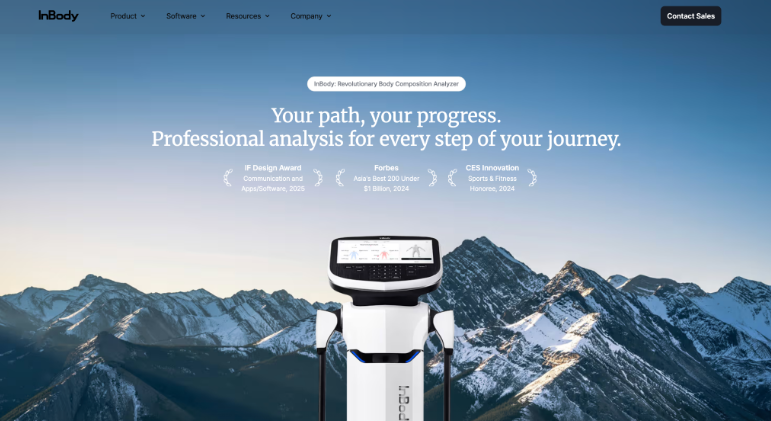
InBody USA builds advanced body composition analyzers in Cerritos, California, using their proprietary DSM-BIA technology paired with an 8-Point Tactile Electrode System. The result is a full-body analysis in under two minutes, which is genuinely impressive for a clinical-grade reading. Any fitness professional looking for a reliable body composition machine at InBody USA will find devices validated at 98% accuracy against DEXA by Mayo Clinic. They serve gyms, corporate wellness programs, and medical facilities, and their product range also includes clinically validated blood pressure monitors and stadiometers.
Why In Body USA Stands Out for Body Composition Machines:
InBody addresses one of the biggest gaps in fitness technology: delivering DEXA-comparable accuracy without the DEXA price tag or the DEXA setup. That kind of clinical validation, backed by Mayo Clinic, is rare and hard to match in the commercial fitness space.
Summary of Real User Reviews:
Clients across wellness centers and performance facilities consistently point to the speed and reliability of InBody’s readings. The two-minute scan time gets mentioned a lot, especially in busy gym environments where client volume matters. Partnerships with organizations like Cincinnati Children’s Hospital and Cirque du Soleil also tell you something about the trust level this brand has built across very different use cases.
2. Akern – Best for Healthcare Professionals and Elite Sports Organizations
What Does Akern Do?
Based in Pontassieve, Florence, Italy, Akern has been building bioimpedance medical devices since 1980. That’s over four decades focused exclusively on one discipline, which shows in the depth of their product line. They manufacture Class IIA Medical Devices, including the BIA 101 BIVA PRO and Nutrilab PRO, serving nutritionists, healthcare professionals, and sports organizations at both elite and amateur levels. With more than 20 proprietary bioimpedance devices developed over the years, Akern sits at the intersection of clinical science and real-world fitness application (not cheap, but built for serious practitioners).
Why Akern Stands Out for Body Composition Machines:
Akern solves the credibility problem that many fitness-facing BIA devices run into, the question of whether the device meets actual medical device standards. Their Class IIA certification and European compliance give sports medicine teams and nutritionists a level of scientific backing that consumer-grade alternatives simply don’t carry.
Summary of Real User Reviews:
Honestly, the profile of Akern’s users says a lot. Elite sports teams and healthcare professionals don’t typically adopt tools unless the data holds up under scrutiny. The scientific partnership angle comes through strongly in how practitioners describe the brand, less as a piece of gym equipment and more as a clinical tool that happens to work in performance settings.
3. ACCUNIQ – Best for Fitness Centers Needing IoT-Connected Body Composition Analysis

What Does ACCUNIQ Do?
ACCUNIQ is a South Korea-based digital healthcare brand with roughly three decades of medical device knowledge behind its body composition and blood pressure product lines. Their BC series body composition analyzers use electrical impedance technology and are built for commercial fitness environments. The BC380 has confirmed 98% correlation to DEXA equipment, which puts it in the same accuracy tier as InBody at a competitive price point. What sets ACCUNIQ apart from many players in this category is its IoT-connected application layer, which lets gyms deliver personalized fitness prescriptions directly to members. Major World Gym chains globally have adopted their BC series, which is a pretty strong endorsement.
Why ACCUNIQ Stands Out for Body Composition Machines:
ACCUNIQ directly addresses the challenge of turning raw body composition data into something gym members actually act on. Their IoT-based application layer bridges the gap between measurement and personalized programming, which is where most body composition devices stop short.
Summary of Real User Reviews:
ACCUNIQ’s reputation is built on accuracy and on the practical business case their devices create for fitness operators. Multiple national and international awards back that up, including the Prime Minister Award and selection as a world-leading enterprise. The BC380’s DEXA correlation confirmation is the kind of third-party validation that facility managers and fitness directors point to when justifying the purchase.
4. Bodystat – Best for Portable Body Composition and Fluid Monitoring
What Does Bodystat Do?
Bodystat has been operating out of Douglas, Isle of Man, since 1990, with a small but highly focused team that has accumulated close to a century of collective in-house knowledge in bioelectrical impedance analysis. Their portable, handheld devices measure body fat, fat-free mass, nutritional status, and fluid shifts without needing a full clinical setup. That portability makes them genuinely useful in fitness centers, pharmaceutical research, and mobile medical settings. The company also maintains ISO 13485:2003 accreditation, and a strong body of peer-reviewed research supports their measurement approach (a surprisingly deep scientific foundation for a two-to-ten-person operation).
Why Bodystat Stands Out for Body Composition Machines:
Bodystat fills a real gap for fitness professionals who need clinical-grade BIA results outside of a fixed facility setup, without the cost barrier of larger commercial devices. Their track record of fitness instructors generating $30,000 to $50,000 annually from The Bodystat Test shows that body composition measurement can work as a direct revenue stream, not just a retention tool.
Summary of Real User Reviews:
Users frequently highlight Bodystat’s affordability and the genuine human accessibility of their customer service, which feels different from the automated support experience that larger device companies tend to offer. The peer-reviewed research backing their technology comes up repeatedly as a trust signal. That usually means practitioners who rely on defensible data make up the core audience here.
5. Evolt Health – Best for Gym Chains and Fitness Networks at Scale

What Does Evolt Health Do?
Founded in 2015 and based in Gold Coast, Australia, Evolt Health built their business around the Evolt 360 Body Composition Analyzer, which delivers over 40 body metrics in 60 seconds using medically graded BIA technology. What’s great about their model is the connected ecosystem around the device: the Evolt Active App, the Evolt Insights Dashboard, and a Bio Wellness Index that turns raw numbers into something members can actually engage with. They serve gyms across three continents, including Anytime Fitness, Curves, and Orangetheory Fitness. With $21.52M in total funding and recognition on the 2025 AFR BOSS Most Innovative Companies list for the second consecutive year, they’re clearly building something with staying power.
Why Evolt Health Stands Out for Body Composition Machines:
Evolt solves the engagement problem that body composition devices typically create: the scan happens, the numbers print out, and nothing changes. Their connected app and dashboard ecosystem keeps members interacting with their data between scans, which turns a single measurement session into an ongoing monitoring program.
Summary of Real User Reviews:
Gym operators who’ve deployed the Evolt 360 tend to focus on two things: how fast the scan process is and how well the app keeps members coming back. The Evolt Active App being a finalist for App of the Year isn’t just an award mention; it reflects real usability feedback from fitness consumers. For multi-location gym businesses, the combination of speed, data depth, and member-facing software is hard to replicate with a standalone device.
Research Methodology and Selection Process
Selecting body composition machines for this guide required a structured evaluation process, not just a product comparison. The goal was to surface options with real evidence of performance across commercial fitness and clinical settings.
Initial Data Collection
The starting point was building a broad list of manufacturers and brands actively serving the fitness technology market. Sources included fitness industry directories, medical device registries, official brand websites, and professional community discussions where practitioners share firsthand equipment feedback. The focus was on companies with documented deployment in gyms, medical facilities, or sports organizations rather than brands with only retail consumer positioning.
Shortlisting Phase
Options without verifiable operating histories, documented clinical or commercial deployments, or traceable third-party validation were removed. Review patterns across multiple platforms were examined to identify consistent feedback themes rather than relying on any single source. Companies where claims on their own websites couldn’t be cross-referenced externally were deprioritized.
Verification of Claims
Each company’s accuracy claims were checked against available clinical validation sources, including DEXA correlation data, Mayo Clinic references, and published peer-reviewed research. Where a brand cited a specific accuracy figure or certification, that claim was confirmed through independent documentation rather than accepted at face value. This step filtered out several brands that made accuracy claims without supporting evidence.
Authority and Industry Contribution Layer
Recognition signals were factored in alongside technical performance. Awards from credible design and technology bodies (Red Dot, iF Design, CES Innovation), ISO and medical device certifications, and inclusion on recognized industry lists all contributed to the company’s standing. Scientific partnerships with elite sports teams or established healthcare providers were treated as strong indicators of real-world trust.
Body Composition Machines-Specific Evidence
The final filter applied fitness technology-specific criteria: dedicated service pages covering body composition analysis, documented gym chain partnerships, verified commercial deployments, and evidence of member-facing applications or reporting tools. Companies that could show actual fitness facility adoption, rather than just device availability, ranked most favorably. The result is a shortlist of five providers with credible, varied approaches to accurate muscle vs. fat tracking across commercial and clinical environments.
How to Choose the Right Body Composition Machines
Picking the right body composition machine comes down to matching the device’s capabilities to your specific setting, whether that’s a clinical facility, a busy gym floor, or a mobile training setup. Accuracy benchmarks matter, but so does how the results get used day to day.
- Industry and Domain Experience: Look for manufacturers with documented years in bioimpedance or body composition. General medical device experience doesn’t automatically translate to fitness-relevant accuracy.
- Features and Service Offerings: Consider whether the device offers segmental lean mass analysis, visceral fat scoring, and BMR estimation, not just a simple body fat percentage. Connected apps and reporting dashboards add real value for member-facing programs.
- Pricing Structure: Clinical-grade devices carry a higher upfront cost (think enterprise pricing for the top-tier models). Factor in ongoing calibration, maintenance, and software fees before comparing sticker prices.
- Results Measurement: Prioritize devices with published DEXA correlation data or peer-reviewed validation. Test-retest reliability is just as important as initial accuracy for tracking progress over 4 to 12 weeks.
- Industry Knowledge and FDA Clearance and Medical Device Certification: Verify FDA 510(k) clearance, CE marking, or ISO 13485 status depending on your market. These aren’t just regulatory checkboxes. They reflect the quality standards the device was built to.
Bottom Line
Body composition measurement has moved well past the simple scale and BMI chart era. The machines covered here each bring a different strength to the table, from InBody’s DEXA-comparable clinical accuracy to Evolt’s connected ecosystem built for scale. Choosing right means matching device capability to your specific setting, not chasing the most well-known name. As demand for performance-focused fitness tracking grows, the gap between serious measurement tools and consumer gadgets will keep widening.
 Ask Cindiy Jensenialez how they got into wellness tips and strategies and you'll probably get a longer answer than you expected. The short version: Cindiy started doing it, got genuinely hooked, and at some point realized they had accumulated enough hard-won knowledge that it would be a waste not to share it. So they started writing.
What makes Cindiy worth reading is that they skips the obvious stuff. Nobody needs another surface-level take on Wellness Tips and Strategies, Mental Health Resources, Fitness Routines and Workouts. What readers actually want is the nuance — the part that only becomes clear after you've made a few mistakes and figured out why. That's the territory Cindiy operates in. The writing is direct, occasionally blunt, and always built around what's actually true rather than what sounds good in an article. They has little patience for filler, which means they's pieces tend to be denser with real information than the average post on the same subject.
Cindiy doesn't write to impress anyone. They writes because they has things to say that they genuinely thinks people should hear. That motivation — basic as it sounds — produces something noticeably different from content written for clicks or word count. Readers pick up on it. The comments on Cindiy's work tend to reflect that.
Ask Cindiy Jensenialez how they got into wellness tips and strategies and you'll probably get a longer answer than you expected. The short version: Cindiy started doing it, got genuinely hooked, and at some point realized they had accumulated enough hard-won knowledge that it would be a waste not to share it. So they started writing.
What makes Cindiy worth reading is that they skips the obvious stuff. Nobody needs another surface-level take on Wellness Tips and Strategies, Mental Health Resources, Fitness Routines and Workouts. What readers actually want is the nuance — the part that only becomes clear after you've made a few mistakes and figured out why. That's the territory Cindiy operates in. The writing is direct, occasionally blunt, and always built around what's actually true rather than what sounds good in an article. They has little patience for filler, which means they's pieces tend to be denser with real information than the average post on the same subject.
Cindiy doesn't write to impress anyone. They writes because they has things to say that they genuinely thinks people should hear. That motivation — basic as it sounds — produces something noticeably different from content written for clicks or word count. Readers pick up on it. The comments on Cindiy's work tend to reflect that.